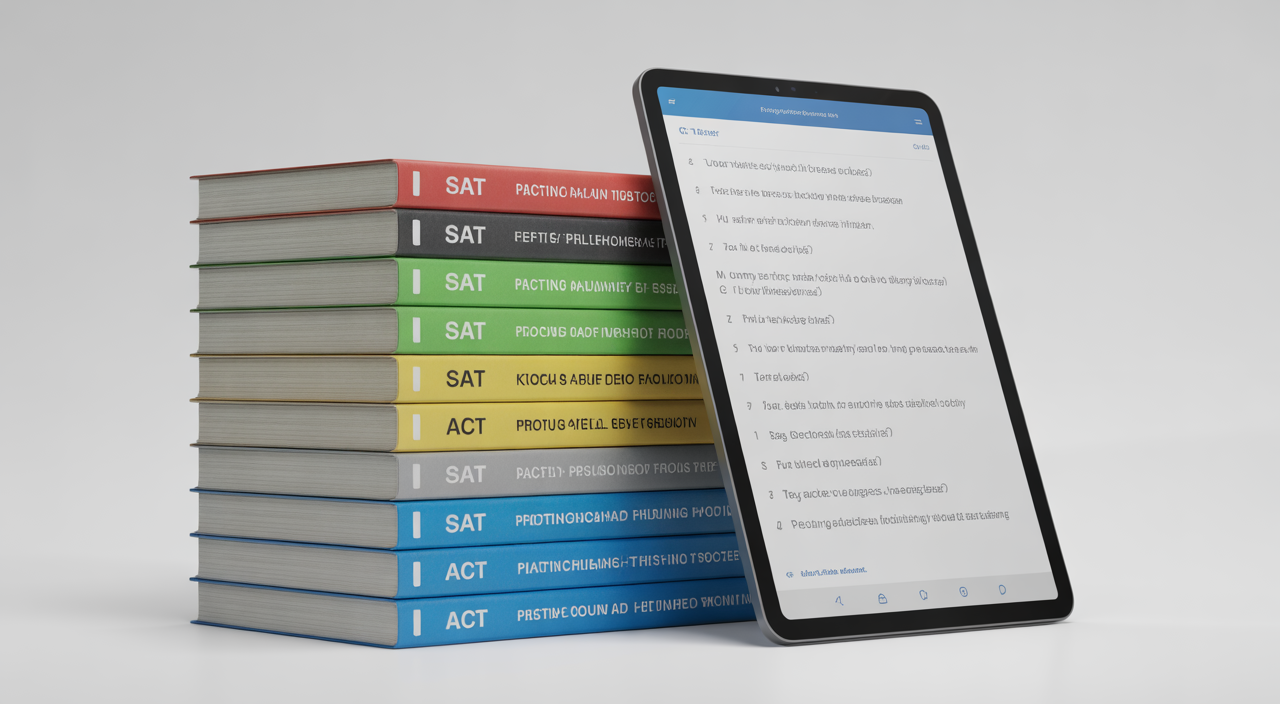
Staring at SAT and ACT brochures and feeling stuck? You are not alone. Almost every student applying abroad asks this same question: SAT vs ACT which is better for me and how do I choose the right one for my goals.
If you want a quick, structured overview with score ranges, timing, and prep tips in one place, check this detailed guide: SAT vs ACT which is better for me. Use it along with this article to decide faster and plan your study schedule with confidence.
This guide will walk you through the basics of both exams, key differences, a simple quiz-style checklist, and clear next steps so you can pick the test that highlights your strengths.
What exactly are the SAT and ACT?
Both the SAT and ACT are standardised entrance tests used by many universities around the world. They help colleges understand your academic readiness in a way that is common across students from different schools and boards.
Today, many colleges are “test optional.” This means you can apply without scores. But strong scores still help your application, win scholarships, and balance a modest school percentage.
Basic structure: SAT vs ACT in simple terms
SAT
- Now primarily offered in digital format in many countries.
- Main focus: Reading & Writing and Math.
- Math has more focus on algebra, functions, data analysis, and some advanced topics that match the high-school syllabus.
- Total score: 400 to 1600.
ACT
- Paper-based in many centres, with some digital options depending on location.
- Four main sections: English, Math, Reading, and Science.
- Science section is about logic, graphs, and data, not detailed school science theory.
- Total score: 1 to 36 (average of the four sections).
Key differences at a glance
Use this quick comparison to see which test may feel more natural for you.
- Timing: ACT has more questions in less time, so it feels faster. SAT is slightly more relaxed on time but has denser reading and math questions.
- Science: Only ACT has a separate Science section. If you enjoy reading charts and experiment summaries, this can be a plus.
- Math focus: SAT math is more word-problem heavy and often tests concepts in a “puzzle” style. ACT math feels more direct and syllabus-like, with a bit more geometry and trigonometry.
- Scoring style: SAT uses 1600 scale, ACT uses 36-point scale. Colleges are comfortable with both.
Mini “Which test fits me?” checklist
Count how many statements feel true for you.
You may like the SAT if:
- You prefer a little more time per question.
- You are strong in algebra, functions, and data interpretation.
- You enjoy reading slightly longer passages and thinking deeply about them.
- You like questions that feel like logical puzzles.
You may like the ACT if:
- You work quickly and do not get stressed by strict timing.
- You are comfortable with a separate Science reasoning section.
- You like direct, straightforward questions without too much trickiness.
- Your school math preparation is strong, including geometry and basic trigonometry.
If you score more “yes” points in one list, start your preparation with that exam. You can always switch later if a practice test shows a different result.
Section-by-section comparison
Math
- SAT: Heavy focus on algebra, linear equations, word problems, and data analysis. Good for students who like logical, step-by-step problem solving.
- ACT: Covers a wider range of topics, including more geometry and trigonometry. Good for students who have finished most of their high-school math syllabus before class 12 board exams.
Reading & English / Writing
- SAT: Reading and Writing are closely linked. It tests vocabulary in context, grammar, and ability to understand complex texts.
- ACT: English section focuses strongly on grammar, punctuation, and sentence structure. Reading section has shorter passages but requires fast comprehension.
Science reasoning (ACT only)
- No separate science section on the SAT.
- ACT Science does not expect you to remember formulas. It checks how well you read charts, experiments, and graphs.
- If you enjoy lab work or data-based questions, this can become a scoring opportunity.
Scoring, superscoring, and conversions
Many universities “superscore.” This means they look at your best section scores across multiple test dates and combine them. This can apply to both SAT and ACT, depending on each college’s policy.
To compare performance, you can use a score-conversion chart. For example, a 31 on the ACT is roughly similar to a strong 1400+ on the SAT. The exact mapping changes slightly by year, so refer to a current chart included in the quick reference guide.
When you are thinking about SAT vs ACT which is better for me, score conversion helps you see where your natural strength lies after trying one practice exam of each type.
How Indian students can choose smartly
As an Indian student, you are often juggling board exams, entrance exams, and sometimes preparation for professional courses. Time is limited, so your goal is to pick the test that needs the least “extra” effort beyond your current studies.
- If your school focuses strongly on math and science, and you solve numerical questions quickly, ACT may feel more familiar.
- If you prefer conceptual thinking, logical puzzles, and detailed reading in English, SAT might align better.
- If you are planning a busy year with projects or internships, choose the test that fits your natural skills so prep feels lighter.
Planning your study path is a lot like planning any other long-term project. For more on that style of thinking, you might enjoy this guide on choosing a financial advisor for your goals, which also focuses on matching choices to your personal situation.
Simple prep timeline that works
Here is a practical approach you can follow, even with a busy Indian school schedule:
- Month 1: Take one official practice SAT and one official practice ACT. Do not prepare first. Just see which feels more natural.
- Month 2: Compare your scores with a conversion chart. Pick the test where you are already closer to your target college’s average scores.
- Months 3–4: Study 6–8 hours per week. Focus on weak sections only. Use topic-wise practice and timed mini-tests.
- Month 5: Take a full timed mock every week. Adjust your strategy for time management and guessing.
- Month 6: Take the official exam. If needed, plan one retake after 1–2 months of focused revision.
FAQs on SAT vs ACT
Q1. Which test is easier, the SAT or ACT?
Neither test is universally easier. The ACT feels easier to some students because questions are direct, but timing is tight. The SAT feels easier to others because there is slightly more time, but questions can be more puzzle-like. The best method is to try one full-length practice of each and compare both your score and your comfort level.
Q2. Do universities prefer one test over the other?
Most universities that accept standardised tests treat the SAT and ACT as equal. They simply convert scores to their internal scale. What matters more is how your score compares to the typical range of admitted students at that college, your school grades, and your overall profile.
Q3. Can I switch from one test to the other later?
Yes, you can. Many students start with one exam, see their practice results, and then switch if they feel another test showcases their strengths better. Just be sure to check registration deadlines and leave enough time to prepare properly for the new format.
Q4. How many times should I take the SAT or ACT?
Most students take their chosen test 1–3 times. After two serious attempts with focused preparation, scores usually stabilise. Beyond that, it is often smarter to spend time on essays, activities, or scholarship applications rather than endless retakes.